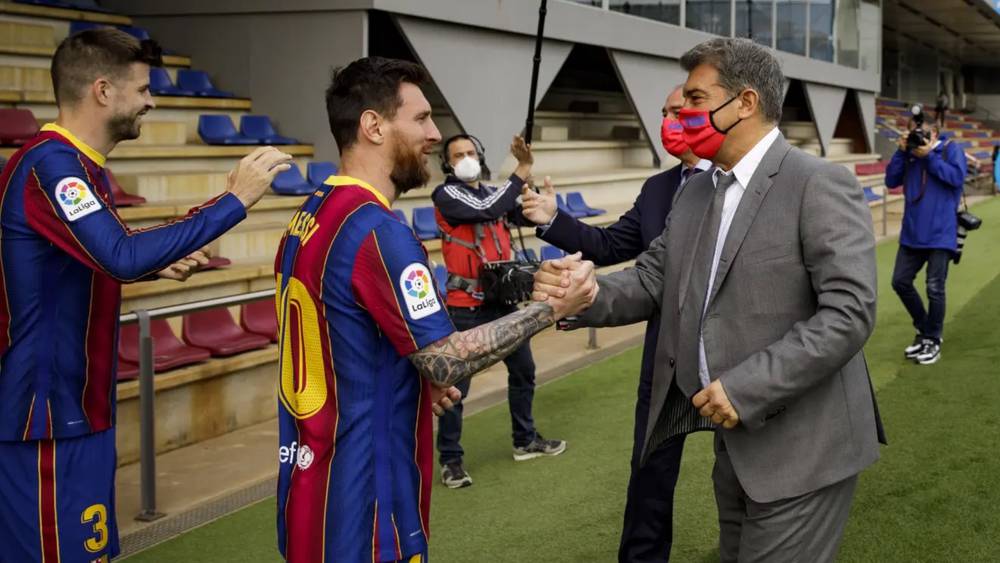
Laporta Admits: Messi Relationship Damaged Post-Barcelona Exit
The echoes of Lionel Messi's departure from Barcelona still reverberate, a painful memory for fans and, as recent admissions reveal, for those at the very top of the club. Joan Laporta, the president responsible for both Messi's initial rise and his eventual, heart-wrenching exit, has candidly confessed to a significant deterioration in his relationship with the Argentine superstar. This revelation casts a new light on one of football's most impactful sagas, highlighting the emotional toll that even the most celebrated partnerships can endure amidst the harsh realities of professional sport. While the bonds forged during the glittering era of laporta messi guardiola once seemed unbreakable, the passage of time and the weight of difficult decisions have clearly left their mark.
Laporta's comments bring to the forefront the complex interplay of power, loyalty, and financial constraints that ultimately led to Messi's farewell. It’s a stark contrast to the earlier golden age, where the harmonious relationship between player, coach, and president laid the foundation for unprecedented success. Understanding this evolving dynamic requires delving into the separate, yet intertwined, histories of these three monumental figures.
The Rift Revealed: Laporta's Candid Admission on Messi
In a surprising and forthright statement, Joan Laporta opened up about the current state of his relationship with Lionel Messi. "The relationship with Messi is not what it used to be," Laporta admitted, painting a picture of a bond fractured by circumstance. He recounted a specific, poignant incident at the Ballon d’Or ceremony: "There was also an an incident at the Ballon d’Or ceremony where I went to greet him and he felt that we shouldn’t greet each other. The relationship has been damaged, but he is a legend of Barcelona."
This public snub, detailed by the president himself, underscores the depth of the personal hurt felt by Messi. It speaks volumes about the perceived betrayal or misunderstanding that must have occurred during the agonizing period of his departure. While Laporta continuously refers to Messi as a "legend of Barcelona," a title no one disputes, the personal connection has clearly soured. The emotional residue of Messi's departure, a move necessitated by Barcelona's dire financial situation and La Liga's stringent salary caps, appears to have weighed heavily on both parties. For a club president, navigating the departure of a player of Messi's stature is arguably the most challenging task, balancing financial prudence with sentimental legacy. The incident at the Ballon d’Or suggests that despite the professional acknowledgment, the personal chasm remains significant. This situation offers a valuable lesson in crisis management: even when decisions are financially unavoidable, the impact on human relationships can be profound and long-lasting, demanding extreme sensitivity and clear communication throughout the process, which perhaps was lacking in the chaotic final days of Messi's Barcelona tenure.
A Golden Era Forged: The Messi-Guardiola Symbiosis
To truly grasp the poignancy of Laporta's admission, one must recall the halcyon days when the trio of laporta messi guardiola, albeit with Laporta in his first presidential stint, spearheaded an era of unparalleled dominance. Central to this golden age was the transformative partnership between Lionel Messi and manager Pep Guardiola. In their four seasons together at the Nou Camp, Barcelona secured an astonishing 14 trophies, including three La Liga titles, two Champions Leagues, and two Club World Cups. It was under Guardiola's meticulous guidance that Messi truly blossomed into the undisputed best player in the world, securing his first Ballon d’Or in 2008-09 and retaining it throughout their time together.
Their relationship, though deeply successful, was far from simplistic. Described by insiders as "always good, closer at some times than others, but always good," it was a complex interplay between two incredibly driven and intricate personalities. Guardiola, upon his presentation as Barcelona’s head coach in 2008, initially stated, "We can’t allow Messi to bear the weight of the team," only to swiftly implement a plan that placed the then 21-year-old Messi at the absolute heart of his revolutionary system. He understood that managing Messi’s prodigious talent required not just tactical genius but also astute man-management.
A prime example of Guardiola’s approach came during the 2008 pre-season. Messi, eager to play for Argentina in the Beijing Olympics, clashed with the club, who needed him for a Champions League qualifier. Guardiola seized this opportunity to show unwavering support, convincing club president Joan Laporta that allowing Messi to pursue his Olympic dream, despite the short-term loss, would secure his gratitude and long-term commitment. This strategic decision by Guardiola, supported by Laporta, underscored a fundamental priority: keeping Messi happy. Public flattery and constant reinforcement were key tools in Guardiola's arsenal to maintain the superstar's morale and performance.
By the time Guardiola departed in 2012, the power balance had shifted, and a separation was mutually beneficial. Yet, the professional respect endures. As one source noted, "Guardiola has not won another Champions League without Leo — he will know that with Leo, he was a better coach. And Leo has never won so much again either, so that professional respect will always be there between them." Their shared legacy is a testament to what happens when supreme individual talent meets visionary tactical leadership. For a deeper dive into their remarkable journey, explore Messi & Guardiola: The Triumphs, Tensions, and Lingering Legacy and Guardiola and Messi: Why Ultimate Glory Needed Both Legends.
The Unspoken Weight: Barcelona's Legacy and Emotional Scars
The stark contrast between the collaborative success of the Messi-Guardiola era and the eventual fractured relationship between Laporta and Messi highlights the enduring challenges of modern football. The emotional weight of Messi's departure was immense, not just for the fans but for the individuals involved. For Laporta, who presided over the club during both the highest highs and the ultimate low of Messi's exit, the experience has clearly left a lasting impact.
Clubs constantly grapple with the dilemma of managing iconic figures – separating the business necessities from the emotional bonds that define their history. When a club faces existential financial threats, as Barcelona did, difficult decisions become unavoidable, often at the expense of sentimentality. The Laporta-Messi situation serves as a powerful reminder that even the most legendary relationships can be strained to breaking point when faced with overwhelming economic pressures. The challenge for any club leadership is to manage these transitions with utmost transparency and empathy, minimizing the personal damage even when the professional outcome is painful. This case study underscores how crucial it is for clubs to proactively communicate and prepare for the eventual departure of their legends, rather than allowing circumstances to dictate a rushed and emotionally charged exit.
Reconciling the Past: Can Wounds Heal?
Despite the current strain, Laporta's unwavering acknowledgment of Messi as a "legend of Barcelona" leaves a sliver of hope for future reconciliation. Time often has a way of healing wounds, allowing both parties to reflect on the circumstances with greater perspective. The professional respect between Messi and Guardiola remains undisputed, a testament to their shared achievements. Perhaps, in time, the personal relationship between Laporta and Messi can also find a path towards a more cordial understanding, if not a complete restoration of their former closeness. The narrative of laporta messi guardiola is, after all, deeply intertwined with the very fabric of FC Barcelona's modern history.
The story of Joan Laporta, Lionel Messi, and Pep Guardiola is more than just a chronicle of trophies and transfers; it’s a profound exploration of human relationships at the pinnacle of professional sport. From the collaborative genius that birthed an unforgettable era of dominance to the painful fracturing of personal bonds under financial duress, their interwoven paths illustrate the delicate balance between ambition, loyalty, and the unforgiving realities of the game. Laporta’s admission serves as a poignant reminder that even amidst the glory, football leaves its emotional scars. While the damaged relationship between Laporta and Messi is a regrettable chapter, the indelible mark left by all three figures on Barcelona, and indeed on football history, remains undisputed and forever celebrated.